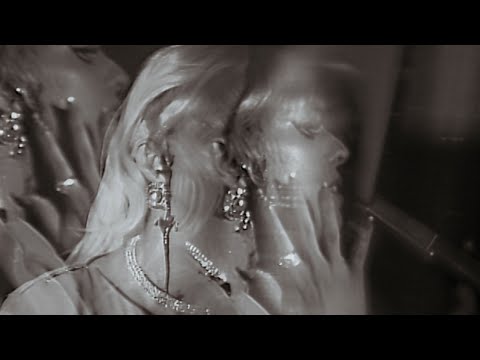
When an artist follows her instinct, rather than money or trends, she can find inspiration anywhere. It was instinct that first led Meg Remy out of her Illinois hometown as a teenager in the early aughts. Not long after making that initial life-changing departure, it was instinct that led Remy to start performing solo under a plural moniker, U.S. Girls. Decades into her storied career as the visionary behind the now critically-acclaimed U.S. Girls project, it was instinct that led Remy to blurt out “we should make a record together” to guitarist Dillon Watson at a hotel bar in Arkansas after playing a festival in Hot Springs, setting in motion the already classic Scratch It, out June 20, 2025 on 4AD.
Remy is far enough into her career that some great mythology about her floats in the ether of musical celebrity. One evening after seeing U.S. Girls perform, an interested 4AD representative gave Remy his card—an opportunity that many unsigned musicians would jump at—only to have Remy tucking away the contact information until a few years later, deciding for herself that she needed to develop more as an artist before thinking about joining any world- renowned record labels. The cover of Half Free (2015), her first LP with 4AD upon signing, was a visual nod to Bruce Springsteen’s Darkness on the Edge of Town; years later at a festival somewhere in Canada and on the heels of breakthrough success with In a Poem Unlimited (2018), Remy would walk up to Jake Clemons, saxophone player for her working class musical hero’s E Street Band (and nephew of the late great Clarence Clemons), asking him to join the Poem live band in closing out their set. The resulting fever dream festival finale led to Clemons ripping a sax solo on Poem’s follow-up, Heavy Light (2020)— not necessarily closing, but synthesizing an important chapter in Remy’s musical evolution. If instinct were an instrument, Remy would be a virtuoso.
In early 2024, following the success of the previous year’s delightfully glossy Bless This Mess and a compilation of live U.S. Girls performances from 2018 to 2023 (Lives), Remy got an offer to play at a festival in Hot Springs, Arkansas— a city more than one thousand miles away from her home in Toronto. She found herself faced with a common conundrum of touring musicians in the inflation-normalization era: how to make a one-off festival performance with a full band financially palatable. While looking at a map, Remy remembered her friend Dillon Watson (D. Watusi, Savoy Motel, Jack Name), who she met years earlier when Watson was on tour and passing through Toronto. (Remy and Watson had bonded over their lifelong love of American oldies.) Watson lived in Nashville, which was half the distance of Toronto to Hot Springs. She called up her friend and asked if he might help her assemble a one-time band for the festival show. Watson obliged. During a total solar eclipse, the festival stint went so well that Remy decided to ride that energy right back to where the impromptu band had initially rehearsed, in Music City itself, and record what would become Scratch It.
With Watson on guitar, Jack Lawrence (The Dead Weather, The Raconteurs, Loretta Lynn) on bass, Domo Donoho on drums, and both Jo Schornikow and Tina Norwood on keys, the primary players assembled at Bomb Shelter Studio, in Nashville. Remy’s longtime collaborator and life partner Maximilian Turnbull came on to co-produce, with Andrija Tokic engineering. Harmonica legend and the “utility man” himself, Charlie McCoy (Elvis, Bob Dylan, Roy Orbison, among others), would join in on some songs too. In just ten days, Scratch It took form, recorded live off the floor with minimal overdubs and mixed to tape. The warmth and authenticity of the songs is immediate, a testament to the prepared and confident crew on both the floor and in the control room. A closeness and ease emanates from the core band—Watson, Lawrence, Donoho, Schornikow and Norwood, who’ve been playing together for years— with Remy’s singular voice sparkling on top of every tune, the most relaxed it has ever been.
Album opener “Like James Said” is an ELO-styled nugget of AM gold and a nod to James Brown about the healing power of dancing alone. Remy’s own lyrical response to Brown’s “Get Up Offa That Thing” showcases her great— and characteristically tragicomic— phrasing, notably on the exaggerated pause in the line, “I’m the queen of exercising [...] pain.” Second song “Dear Patti” kicks off similarly, with Remy’s biting humor piercing through before shifting to an aching rumination on power dynamics, idol worship, and new motherhood. Reflecting on a one-time festival co-bill with the legendary Patti Smith, Remy laments: “Patti I didn’t get to hear you play / I was making sure my kids didn’t fall in the lake / I was trying to make myself so small / In that space I had no place being at all.”
“Walking Song” and lead single “Bookends,” both co-written with Edwin de Goeij, make up the heart of the album. Where the four-minute “Walking Song” spins classic hymn “Just a Closer Walk with Thee” into a rumination on young love, “Bookends” is a sprawling, twelve-minute ballad paying tribute to Remy’s deceased friend and former Power Trip frontman Riley Gale, through the lens of Remy’s own reading of John Carey’s Eyewitness to History.
Remy continues her tradition of interpreting other songwriters with “Firefly on the Fourth of July” and “The Clearing,” written by Alex Lukashevsky and Micah Blue Smaldone, respectively (fans of In a Poem Unlimited will recognize Smaldone as the writer of “Time,” the final track of that album). “Emptying the Jimador” is a raw analysis of the artist’s relationship with alcohol, written after a tequila-fueled performance (and solo after party) at Toronto’s legendary Massey Hall. The song’s direct and heartfelt tone carries over into “Pay Streak,” about the Canadian gold rush, written with Kim Biggs after a trip to the Yukon. Final song “No Fruit” is a slinky funk diss track, with Watson’s wah-wah punctuating Remy’s biting and poetic prophecy, which could be aimed at a lover or the greater modern world: “If you don’t plant with the moon in mind / You will surely suffer shallow roots / When harvest time comes the picker will find / You got no fruit.”
As a whole, Scratch It weaves together country, gospel, garage rock, soul, disco, folk balladry, and more. Remy’s masterful songwriting is the thread. The artist’s discarding of the more computer-based production of 2023’s Bless This Mess in favor of two-inch tape serves the songs well, and is just the kind of sonic shapeshifting we’ve come to expect from an artist nearly twenty years into making records.
Paradox underlying Remy’s U.S. Girls persona has been well-covered (wait, there’s only U.S. Girl? And she doesn’t even live in the U.S.?!— and so on). The unstoppable charm, and maybe the only connection to her ‘American-ness’ worth noting, is Remy’s affection for and sometimes embodiment of the underdog, a classic archetype of American culture. Remy’s instinct and grit have taken her far. However, where she necessarily separates herself from the toxic bootstrap mentality is her insistence on putting not the image of the rugged individual front and center, but what lies beneath the surface: her vulnerability. “Don’t you know to live / Is to lose face.” Scratch It and see.